
Notes
This is a place for thinking out loud, reflecting, and sharing ideas. Notes are a window into my process, thoughts, inspiration, and experiments. Explore visual gallery.
This is a place for thinking out loud, reflecting, and sharing ideas. Notes are a window into my process, thoughts, inspiration, and experiments. Explore visual gallery.
Pick an object around you. Look at it for 30 seconds. What do you notice?
Now, stand up and move to either side of the object. Look for 30 more seconds. What do you see now?
Go back to where you started. 30 more seconds. What do you see now that you did not before?
Whether or not you do this exercise, you might imagine that you will notice something new each time.
Changing perspective opens our eyes.
Sometimes, it can be hard to see new possibilities. We become hyper-focused on our view and never stand up to take a different look. Maybe we are feeling lazy or stubborn, convinced that we have it figured out. In either case, being told that we need to stand will only push us further in our seats. So, what happens when everyone is comfortable sitting down?
It is not worth our energy to try forcing anyone to stand up and sit beside us. Instead, we can get curious. Ask questions. Why are they so content? What do they see from their view?
The more we ask, the more everyone learns, the more engaged we become. Soon, we are all standing, looking around, and together, we can find a way forward.
Early on in the pandemic, I remember being nervous that exercising in my apartment would disturb the downstairs neighbors. Instead of simply texting them and asking, I stacked yoga mats, modified workouts, and did whatever I could to dampen the sound. Burpees are just not the same when you're worried about how hard your hitting the floor.
One day while heading out for a walk, we ran into each other. I mentioned my workouts and asked if it was bothering them. Their response:
"We rarely hear it, and when we do, we actually like it. It's a good reminder to be active. We end up working out or going out for a walk."
The discomfort created by assumptions outweighs any temporary discomfort felt when removing them. The sooner, the better.
"We did that before, and it failed."
So what?
When did you do it?
What were you hoping to achieve?
Were you working with the same people?
Had you done it once already?
Did you know what you know now?
One day, a manager notices a new employee excelling in a specific area of their work. They praise them privately. "Nice work! You're killing it."
For simplicity, let's call this employee Taylor. They turned their design into a motion prototype, and the work is outstanding.
Over the next few weeks, the manager notices a pattern. Taylor's motion prototypes seem to be getting better and better. At this point, they begin praising them in public. "Big props to Taylor! You are an absolute motion master."
Now, whenever there is a motion need, everyone goes to Taylor. Within a matter of months, Taylor spends most of their time working on motion projects.
Last quarter, Taylor watched a few motion tutorials on YouTube. She wanted to bring a design idea to life and thought motion could help. She enjoyed it, but her passion is in design, nor does she consider herself a motion expert.
The more people ask for help, the more complex the requests get. The pressure builds. Most weeks, Taylor puts in late nights to grow her motion skills.
She musters up the courage to let her manager know about the extra hours. Her manager revisits staffing and gets her help with her design projects, so she has more time to work on motion.
A year goes by.
Taylor is home visiting friends from design school. She took an entire week off. Lately, her workdays seem to go on forever. The only way she can think to recharge is to get away.
Her former classmates share all the projects they have been working on at their respective jobs. Taylor scrolls through endless MP4s of motion studies.
Taylor realizes she is now a motion expert.
She returns to work the following Monday and puts in her notice.
No one asked Taylor if she enjoyed working with motion.
Ten years ago today, it was a Thursday.
It had been a week or so since I wrapped my first semester as a TA (Teaching Assistant) at Tyler School of Art, my soon-to-be alma mater.
As the evening set in, I got prepared to celebrate Cinco de Mayo at one of "my" student's apartments. I did not know this night would live on for years to come.
Months prior, this student had requested me on Facebook. I let it linger. See, from day one, I knew that there was positive energy between us. I remember walking in the classroom on my first day as TA. There she was with short blonde hair, wearing a Temple U sweatshirt. I couldn't place what it was about her, but our eyes were like magnets.
I was serious about my new TA position, so I chose to ignore our connection for the entire semester. This evening's festivities would be a big step.
I got on my bike and made my way to a nearby bodega for refreshments. 40 oz beers were the budget-friendly drink of choice. I sprung for Miller High Life, one for me, one for her, and set out for the party.
I'll never forget the bottles in their bags swinging from my handlebars. I did my best to stay balanced while dodging potholes in the dark on the neglected North Philly streets. I wondered if this was what it was like to audition for an act at Ringling Bros.
When I arrived, the look on her face was priceless. What I didn't know was that nearly all of her friends were awaiting my arrival. She had been telling them about our apparent connection for months. No one fully believed her, but they all had some expectation of who this TA character might be. Now, there I was, standing on her doorstep. No longer a TA, just a guy, eager to see a girl, refreshments in hand.
You may have caught on by now, but that student is now my wife, Dana. We made some great memories that night.
I chose to share this story today because, for about a decade now, I return to it every year on May 5, and I laugh. I hope it brought a smile to your face, even just the slightest.
"What we need in life, in the arts, in sports, is to loosen up, to become flexible, to get to a place where there is nothing in our way—including our own obsession with certain outcomes." (Stillness is the Key, Ryan Holiday)
During childhood and young adulthood, I had a vision for my future. There were outcomes I was after, and each step was part of a plan to get there. According to my mother, at about age five or six, I hoped to own a station wagon and have seven kids. Don't ask. I have no idea. As I grew up, my vision evolved; touring full-time as a musician, teaching high school art, owning a design studio with my wife, Dana.
Here I am, years later, and in terms of a career, none of these have come true. Am I any less happy with my path? No.
In May 2017, just four years ago, I was offered the partner role at Barrel. It was a pivotal moment in my career. In my mind, I had a choice. Either I seize the opportunity in front of me. Or, I give it all up to go after my vision of opening a design studio purely because it had always been my plan. I knew that if I went after the former while aspiring to do the latter, I'd give neither the attention they deserved.
As I deliberated over my decision, I realized that I was no longer chasing an outcome. I was enjoying the ride. My path at Barrel was not one I would have predicted. I came in every day focused on doing my best and welcomed every new opportunity with open arms. It was invigorating, and the challenge of becoming a partner was no different. Why walk away?
This experience forever changed my outlook. We cannot predict what life will throw our way. If we get too attached to our plan or outcomes, we risk missing the possibilities right in front of us.
My future is no longer about a specific outcome or plan. Instead, I'm focused on creating a future I want to live in, at work and at home. I have learned to be flexible in how I get there, and what I value most is feeling good along the way.
We love to say we have no time, myself included. We act as if everyone else is working with a 24+ hour day.
Then, out of nowhere...
All of these situations throw off our day, but we make it work.
We...
In truth, we know that we are all working with a 24-hour day. The difference is in how we use it. When we say we have no time, what we are really saying is that we have decided that another commitment is more important.
Emergencies help us see where our real priorities lie.
Every morning I wake up, grab my journal from under the bed, turn to one side, and begin writing. I always wonder if my wife Dana is curious about what I am writing. I know I would be.
Out of the blue last Saturday morning, with 144 consecutive journal entries logged, Dana asked me if I would read one for her. My suspicion was correct, but it still caught me off guard. Initially, I was hesitant to oblige. The writing in my journal was not for an audience, but hey, I had nothing to hide.
I read Dana an entry from March. It was the first time since I began journaling that I turned back the pages. It was fascinating to read aloud what was on my mind even just a month ago. In the end, I am grateful for Dana's interest; it was a welcome reminder of why I started journaling in the first place.
While I write in my journal to reflect on the previous day and acknowledge how I feel heading into the next one, I see it as a long-term initiative. Years from now, I love the idea that I can tap into my former thoughts, motivations, and challenges. What was going on in my life? What has changed? In what ways have I grown?
Today, when I stumble upon old photos, I wonder what was on my mind. On any ordinary day, and during pivotal high and low moments in my life. Some good memories that come to mind are performing original music for the first time at my 8th grade talent show, winning Amateur Night at the Apollo, landing my first job in New York City, my first date with Dana then proposing/getting married.
Although I may not be able to revisit these past moments in the way that I would like, I look forward to capturing all that the future has to offer.
I have adjusted the structure of my journal entries a few times since I started. At the moment, here is what it looks like:
Day, Date, Time, Location
Yesterday was [sum up the day in a few words].
Today: TFWEG
I created TFWEG as an easy, repeatable way to recognize my general sentiment going into the new day.
+
Time blocking up front is actually easy. Just go to your calendar and do it. The real challenge is to honor the system by protecting the time you’ve set aside and utilizing it with absolute focus in the face of the inevitable barrage of false priorities and interruptions that appear each day. (The Millionaire Real Estate Agent, Gary Keller, Jay Papasan, Dave Jenks)
I vaguely remember when I first started time blocking my calendar. I was transitioning from solely designing to overseeing other projects. More projects meant more meetings. At times, it was challenging to make progress on my work.
In theory, scheduling work blocks on my calendar provided the space I needed in my day. In practice, it was not that simple.
Interruptions, double-booking, questions - you name it. There were all sorts of reasons why it became a challenge to honor the time blocks I put in place. I had fooled myself into thinking that time blocking was a turnkey solution to improving productivity.
While I continued time blocking my calendar, I shifted my focus to creating a more robust system for task management and started questioning where I could be most valuable. As I continued on the path from designer to director, this shift proved to be invaluable.
I have been on a productivity optimization quest for years, and in my mind, it is a lifelong pursuit. Here are a few of the lessons I have learned along the way.
Question every meeting. Why were you invited? What is the team expecting from you? If you are unsure, ask. Will you provide anything to the discussion that will not otherwise get covered? Note: If you are attending because you do not trust your team to handle it on their own, closing that gap is a priority.
Stop repeating yourself. What topics require repetitive training among the team? Some examples: presentation prep, the structure of deliverables, how to recap a meeting. Take the time to document the fundamentals. Onboard the team, but more importantly, closely train a few employees. In time, they will train other employees, who will train more employees down the line.
Find your value. What unique value do you bring in your role? The answer to this question is where you should spend your time. From time to time, you may need to jump in and help with other tasks. That said, your focus should be on letting go. You do not need to be in the weeds on every single project. Yes. You will always have good insight, but that does not mean the team will fail without it. Give your team the tools to succeed and let them do their thing. The best managers go unseen.
There are two common ways to unclog a drain.
Option 1. Use a snake.
Option 2. Pour in a bottle of Drano.
Both will achieve the desired result. The difference is that while snaking the drain may require more effort, it will expose whatever is causing the blockage.
The quick and easy solution is always tempting, but when you haven't addressed the source of the issue, there's no guarantee it'll stick.
A friend once shared a tip from a dietitian he worked with as a child. They said: don't take another bite until you've finished chewing the last.
Overeating is often associated with eating too fast. Our body can't keep up to let us know we're feeling full.
Ever bite off more than you can chew?
Work and food are the same. There's a certain amount we need to stay energized. When we discover what we enjoy, we crave it. We want more. And more. And more. Until suddenly, we've had too much. Then, the reverse happens, we get tired, sick, unmotivated. We want nothing to do with the work or food that once brought us joy.
Slow down. Experience every moment before taking another bite.
It's been about 14 months since I posted this tweet. I remember writing it just after finishing my routine Saturday workout. Little did I know, I'd start working out at home, in my bare feet, a week later.
I haven't worked out with shoes on since.
We can’t always control changes to our environment.
We can always control how we respond to them.
This evening, Dana and I met up with our friend Andres for dinner at a semi-new pasta joint in our neighborhood. We hadn't seen Andres for over a year.
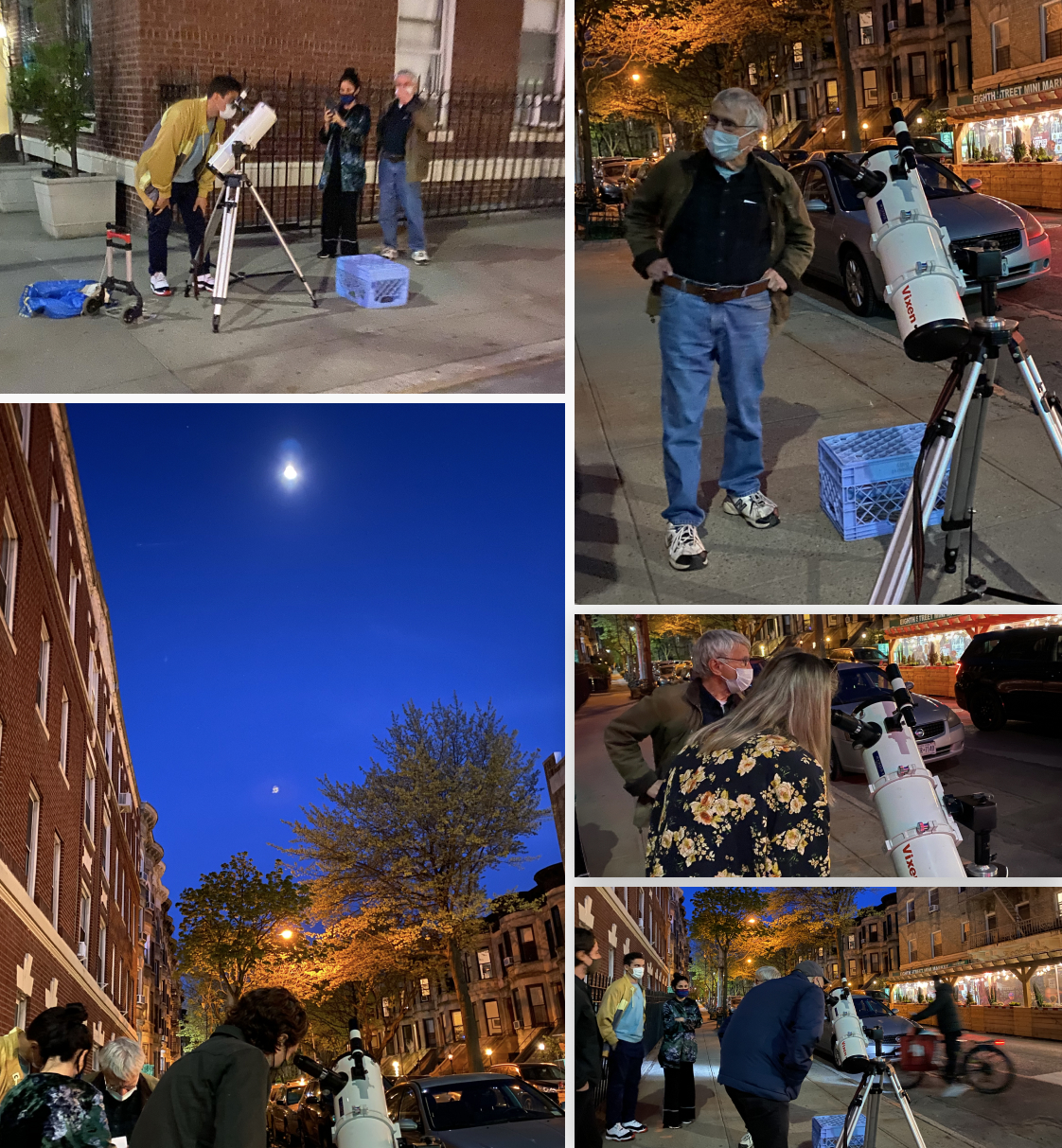
Despite the increasingly frigid air, we decided to round out our meal with ice cream. It seemed like everyone around us was ordering it, so we joined in. As we took our final spoonfuls, an older man appeared at our table. He announced: "Come see the moon when you finish! I'm right over there." He pointed across the street. We smiled. He nodded, then continued his message down the other tables lining the sidewalk.
I'll admit, my first thoughts were I am freezing, I want to go home and be warm, why is this guy talking to us? Dana, on the other hand, was curious. Her thoughts? "He's a nice man. We should go."
While we waited for the check, we assessed the situation. Across the street was a serious-looking telescope. We watched as the man brought over a waitress, then a couple, then another couple. Maybe there was something to see?
After paying the bill, Dana, Andres, and I stood up from the table, looked at each other over our face masks, and together, declared: "Let's go see what's going on."
The telescope operator's name was Joe. When we walked over, he was chatting with a local couple who, like Joe, lives nearby. He sets his telescope up in spots throughout the neighborhood from time to time and likes to share the experience with others.
Dana, Andres, and I each took turns looking at the moon. With the city sky remarkably clear tonight, the view was incredible. To quote the guy who had a look before me, "It's like I'm staring at the set of Star Wars, except it's real." As I gazed upon the moon's craters, I immediately understood why Joe was out on the street. Seeing the moon with this level of detail is not an experience you want to keep to yourself.
We briefly chatted with Joe and found out that he was collecting emails to let any locals know when he'd be out again. Well, yeah - I wanted to know! I "joined his mailing list" via pen and scrap paper.
It's times like these that remind me why you can't always trust your gut. I'm glad I have Dana to make me think twice sometimes, so I don't miss out on the joy of little moments like tonight.
Cheers to Joe, the moon guy, and the characters of Park Slope.
It only takes a moment to win.
It's the second that your first to cross the finish line. It's the second that you find out you lifted the most weight. It's the second that a client accepts your proposal.
It takes days, months, years to practice.
It's all the work that came before you approach the finish line, pick up the weight, send your proposal.
If we're only happy when we win, we'd have to win constantly to live a happy life. What happens if we don't?
When there's joy in the practice, winning is just a bonus.
When is the best time to promote an employee?
I like to think that there's a sweet spot. The employee has outgrown their current position, but their next role will challenge them in new ways. In the book Atomic Habits, author James Clear highlights a similar concept:
"The Goldilocks Rule states that humans experience peak motivation when working on tasks that are right on the edge of their current abilities. Not too hard. Not too easy. Just right."
It's a manager's job to guide their employees from role to role by giving them the right opportunities and coaching them along the way.
In that way, the employee needs to have enough exposure to some of the new role's responsibilities and shown they're ready and capable for the challenge. For instance, before promoting a Junior Designer to Designer, they should have opportunities to present their work if that's an expectation of the new role. I'm not suggesting they lead a high-stakes presentation. Instead, maybe they walk through design revisions or take on a portion of a meeting.
Promotions are most successful when the employee feels equipped for the next step, their manager is confident in their ability to take it on, and their co-workers are beginning to see them in the new role.
+
Related: Building Teams with TLC


